Hell Cat Cowgirl Riding Tiger Shirt SVG
First Impressions: Bold, Playful, and Unapologetically Graphic
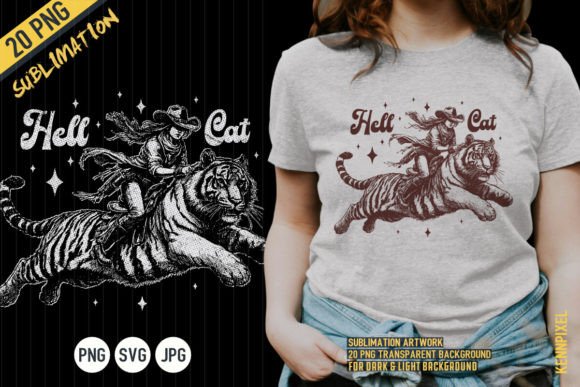
Opening the Hell Cat Cowgirl Riding Tiger Shirt SVG zip folder, I immediately noticed how cleanly the vector shapes separate—100 distinct paths in Illustrator, no overlapping mess or hidden layers. This isn’t just “cute” or “edgy” as a label—it’s a confident visual statement: a stylized cowgirl astride a snarling tiger, both rendered with sharp silhouettes, exaggerated posture, and intentional negative space. The composition leans into graphic simplicity rather than photorealism, which is smart for embroidery translation. It feels like a hand-drawn tattoo flash sheet—bold enough to read at a glance, detailed enough to hold interest up close, but never so intricate that it collapses under dense stitching.
A Real-World Test: Embroidering It on a Linen-Cotton Tote Bag
Last week, I prepped this design for a custom order: a medium-weight linen-cotton tote for a local boutique’s summer launch. Not a t-shirt—intentionally. Why? Because the Hell Cat Cowgirl Riding Tiger Shirt SVG thrives where texture and scale meet intention. On smooth cotton tees, it reads fast and fun. But on a structured, slightly nubby tote? It becomes a conversation piece—confident, wearable art. I used a 4-inch hoop, medium-cutaway stabilizer, and tested three thread palettes (black-on-cream, rust-on-navy, and charcoal-on-sage). All worked—but only because the design’s outlines are crisp, its interior fills generous without overcrowding, and its largest shape—the tiger’s head—has breathing room between stitches. No skipped satin stitch zones. No tiny floating elements that vanish in fill stitch.
Where It Shines (and Where It Needs Caution)
This is not a one-size-fits-all embroidery file. Its strength lies in intentional placement and thoughtful execution:
- Custom apparel & sweatshirt embroidery: Works beautifully on crewnecks and relaxed-fit tees—especially when centered or placed high on the chest. Avoid tight side seams or curved ribbing unless you reposition key shapes to avoid distortion.
- Embroidered patch & tote bag design: Ideal scale and contrast. The clean vector edges translate cleanly to heat-applied or sewn-on patches.
- Holiday embroidery & personalized gifts: Great for quirky Christmas stockings, birthday pillow covers, or baby embroidery (if stylized gently—this isn’t pastel nursery fare, but works well on unisex toddler hoodies).
- Craft business & Etsy seller use: Strong visual identity. Buyers recognize it instantly—it doesn’t get lost in thumbnails or mockups. Pair it with simple typography for shop branding, and it holds its own.
But proceed thoughtfully on:
- Thin or stretchy fabric: The tiger’s open mouth and cowgirl’s lasso loop rely on stable tension. Use tear-away + cutaway hybrid stabilizer—and test first.
- Dark fabric: That high-res JPG and 22 PNGs help immensely here. Preview your thread colors against dark backgrounds using the included files before stitching.
- Curved surfaces (caps, beanies): The horizontal orientation and wide silhouette make it less ideal for front-of-cap placement unless resized to ~3.25" wide and re-hooped with precise digitizing adjustments.
- Frequent-wash items (baby clothes, kitchen towels): Avoid ultra-fine details like eyelashes or whiskers—they’re not present here, thankfully. What is present—solid outlines and balanced fill stitch—holds up well with proper stabilizer and quality thread.
Design Assets That Support Real Workflow
The file package isn’t over-engineered, but it’s purpose-built. One SVG with 100 vector shapes means easy recoloring, scaling, or isolating elements (say, using just the tiger head for a minimalist apron design). The single 300DPI JPG gives instant print-and-go proofing. And those 22 PNGs? They’re not filler—they’re likely varied sizes and color modes (grayscale, transparent background, white-on-black) perfect for digital product previews, Etsy listing mockups, or client approvals. As a designer who ships 50+ custom embroidery projects yearly, I value assets that reduce back-and-forth—not just “more files,” but better-aligned files.
What It Adds to Your Finished Product—Beyond Stitching
This isn’t just about thread count or hoop size. It’s about perceived value. A customer ordering a handmade tote with Hell Cat Cowgirl Riding Tiger Shirt SVG doesn’t just get embroidery—they get attitude, story, and visual cohesion. It elevates a generic item into something curated. For Etsy sellers, that translates to better click-through rates on listings, stronger repeat buyer trust (“they know bold design”), and easier bundling (e.g., matching pillow + towel + tote sets). For craft fair vendors, it stands out among softer, busier designs—without shouting. And yes, it photographs well. The strong contrast and clear shapes pop in natural light, no heavy editing needed.
Practical Embroidery Designer Notes Before You Stitch
Before cutting fabric or loading your machine:
- Test the Hell Cat Cowgirl Riding Tiger Shirt SVG on scrap fabric *with your exact stabilizer and thread*—not just “similar.” Linen behaves differently than cotton jersey.
- Check stitch density visually in your embroidery software. If fill areas look overly dense, adjust underlay or reduce density by 5–8%—especially on medium-weight fabrics.
- Review small details: the cowgirl’s hat brim, tiger’s stripes, and boot heel are defined but not micro-fine. Still, confirm they’ll resolve clearly at your intended size.
- Try black-and-white mockups. Does the design retain personality without color? Yes—because its strength is shape, not hue.
- Verify licensing. This is a digital embroidery file—confirm whether commercial use (selling finished embroidered goods) is permitted before listing on your small shop or Etsy store.
- Use the included JPG and PNGs to build printable mockups for clients. It saves time and sets accurate expectations.
Final Thought: A Design That Earns Its Place
Hell Cat Cowgirl Riding Tiger Shirt SVG doesn’t try to be everything. It’s not delicate lacework, not minimalist line art, not vintage script. It’s a focused, confident piece of graphic storytelling—built for makers who want their handmade product to carry weight, humor, and visual clarity. Used right—with attention to fabric, stabilizer, and context—it delivers professional impact without overcomplicating your workflow. That’s rare. And honestly? That’s why I keep it in my go-to folder for custom apparel, boutique merchandise, and standout personalized gifts.