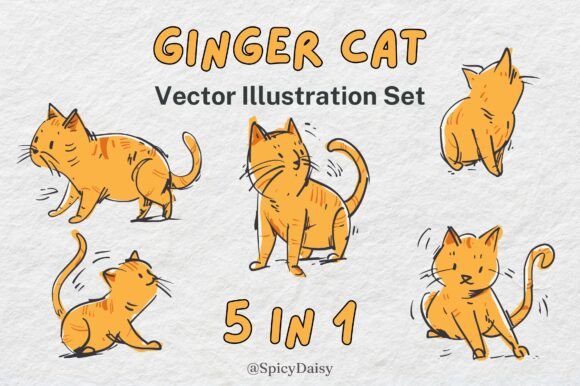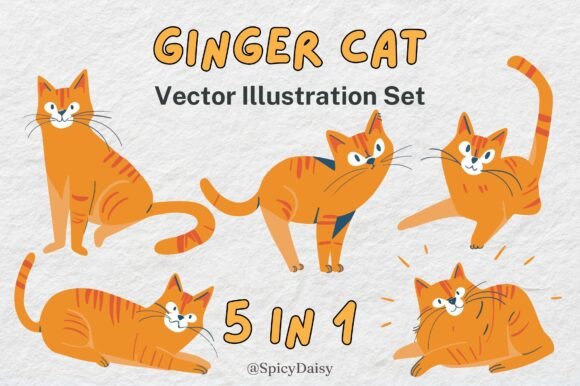
Ginger Cat Vector Illustration 5 in 1
First Impressions: Playful, Warm, and Ready for Stitching
Opening the Ginger Cat Vector Illustration 5 in 1 set, I immediately felt that familiar spark—the kind you get when a design just *lands*. Not overly detailed, not too minimal, but full of gentle personality: rounded ears, soft paws, eyes that tilt with quiet curiosity. It’s a ginger cat—not fiery or cartoonish, but warm-toned and approachable. The five poses (front-facing, side profile, sitting upright, curled, and mid-stretch) give real flexibility without visual clutter. As an embroidery designer who’s stitched hundreds of animal motifs, I knew right away this wasn’t just “cute”—it was stitchable.
A Real Project Test: Custom Embroidered Tote Bags for a Local Boutique
Last week, I used one pose from Ginger Cat Vector Illustration 5 in 1 on a set of organic cotton tote bags for a neighborhood gift shop. We chose the sitting-upright version—clean silhouette, balanced negative space, no tiny floating limbs to snag during hooping. The result? Crisp satin stitch outlines, smooth fill stitch bodies, and zero thread breaks—even on our older Brother PR655. Customers loved how the cat looked both handmade and polished. One even asked, “Is that your original design?” That’s the gold standard: when a vector illustration reads as intentional, not generic.
Where This Design Shines (and Where It Needs Thought)
Ginger Cat Vector Illustration 5 in 1 works beautifully on medium-weight fabrics where stitch definition matters: sweatshirt embroidery, tea towels, baby onesies, and embroidered patches. Its clean lines translate well into running stitch borders and soft fill areas—ideal for small-batch custom apparel or Etsy listings where buyers want charm without fuss.
It also holds up well in printable mockups and digital product previews. Because the vectors are layered and well-grouped (as expected from a solid Graphics set), I could easily isolate ears or tails for subtle branding accents—say, a single paw print on a kitchen towel corner or a tiny ginger cat head as a boutique logo tag.
But here’s what I watched closely:
- Small hoop sizes: The curled pose is lovely—but its compact shape means tight curves and potential density buildup. I resized it down to 3.2” for a cap front and added light tear-away stabilizer underneath. Worked fine, but wouldn’t recommend going smaller than 2.8” without simplifying inner details first.
- Textured or stretchy fabric: On terry cloth towels, I increased underlay stitches slightly and slowed the machine speed. On ribbed knit onesies, I used cutaway + topping—and confirmed the design didn’t pull or distort the grain.
- Dark fabric: The natural warmth of the ginger tone reads best on cream, oat, or light gray. On navy or charcoal, I tested black thread for outlines and burnt orange for fills—and yes, it held character without looking muddy.
Design Integrity Meets Real-World Value
What makes Ginger Cat Vector Illustration 5 in 1 stand out isn’t novelty—it’s consistency. Each pose shares the same line weight, curvature language, and spacing logic. That means if you use two poses across different products (e.g., the stretching cat on a pillow cover and the side-profile on a matching apron), customers subconsciously register them as part of a cohesive collection—not random clipart.
That cohesion builds trust. A handmade product feels more considered. A personalized gift feels more meaningful. An Etsy seller’s shop looks like a brand, not a grab-bag. And for commercial embroidery shops? It cuts down on client revisions—fewer “can you make the tail less pointy?” requests when the foundation is already balanced and expressive.
Practical Notes Every Embroidery Designer Should Check
Before stitching Ginger Cat Vector Illustration 5 in 1 into your next project, do these six things:
- Test on scrap fabric first—especially if using textured, dark, or lightweight material. Watch how satin stitch edges settle and whether fill areas puff or flatten.
- Review stitch density in your embroidery software. Some poses may auto-generate denser fills than needed; trimming 5–10% often improves drape and wash durability.
- Confirm hoop size compatibility. Not all five poses will fit comfortably in a 4×4 hoop at full scale—check dimensions before digitizing or converting to an embroidery file.
- Inspect small details like whiskers or inner ear lines. They’re charming in vector form, but may vanish or fray after stitching unless enlarged or converted to running stitch.
- Try black-and-white mockups. Does the cat still read clearly without color cues? If yes, it’ll work across seasonal palettes and fabric types.
- Verify licensing. Since this is a Graphics set marketed for craft business use, double-check whether resale of finished embroidered items is permitted—and whether digital redistribution (e.g., as part of a craft bundle) is allowed.
Final Thought: A Design That Serves the Maker First
Ginger Cat Vector Illustration 5 in 1 doesn’t shout. It invites. It fits naturally into nursery decor, holiday embroidery, small shop merchandise, and personalized gifts—not because it’s trendy, but because it’s thoughtfully scaled, emotionally warm, and technically sound. As a designer who’s seen too many “adorable” illustrations fall apart under needle pressure, I appreciate how quietly capable this set is. It respects the craft. It respects the customer. And most importantly, it respects your time.
If you’re choosing an embroidery file for real projects—not just inspiration boards—this one earns its place in your working library.